
• About
  • Advertise
  • Contact
Sunday, January 18, 2026
No Result
View All Result
NEWSLETTER
Orthodox Times (en)
  • Home
  • Orthodoxy
    • Ecumenical Patriarchate
      • Dioceses of the Ecumenical Patriarchate
      • Mount Athos
      • Archdiocese of America
      • Archdiocese of Australia
      • Church of Crete
    • Patriarchates
      • Patriarchate of Alexandria
      • Patriarchate of Antioch
      • Patriarchate of Moscow
      • Patriarchate of Serbia
      • Patriarchate of Romania
      • Patriarchate of Jerusalem
      • Patriarchate of Bulgaria
      • Patriarchate of Georgia
    • Churches
      • Church of Greece
      • Church of Cyprus
      • Church of Poland
      • Church of Albania
      • Church of Czech and Slovakia
      • Church of Ukraine
  • Politics
    • USA
    • Europe
    • Middle East
  • Society
    • Greek Diaspora
    • Culture
  • Spirituality
  • Christianity
  • Opinions
  • Home
  • Orthodoxy
    • Ecumenical Patriarchate
      • Dioceses of the Ecumenical Patriarchate
      • Mount Athos
      • Archdiocese of America
      • Archdiocese of Australia
      • Church of Crete
    • Patriarchates
      • Patriarchate of Alexandria
      • Patriarchate of Antioch
      • Patriarchate of Moscow
      • Patriarchate of Serbia
      • Patriarchate of Romania
      • Patriarchate of Jerusalem
      • Patriarchate of Bulgaria
      • Patriarchate of Georgia
    • Churches
      • Church of Greece
      • Church of Cyprus
      • Church of Poland
      • Church of Albania
      • Church of Czech and Slovakia
      • Church of Ukraine
  • Politics
    • USA
    • Europe
    • Middle East
  • Society
    • Greek Diaspora
    • Culture
  • Spirituality
  • Christianity
  • Opinions
No Result
View All Result
Orthodox Times (en)
No Result
View All Result

Saint Luke of Crimea

Jun 11, 2020 | 10:07
in Spirituality
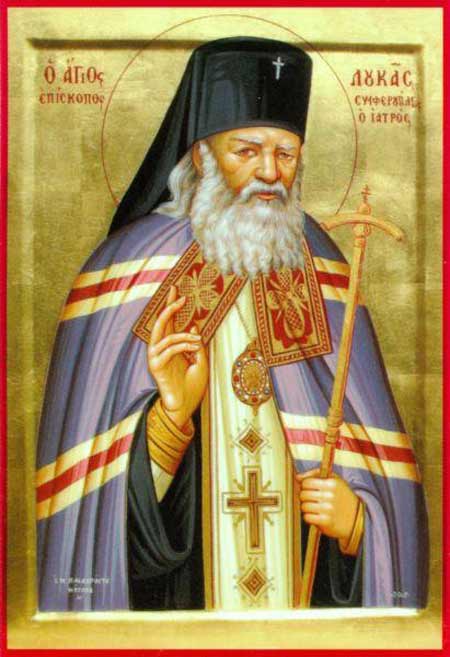
Saint Luke of Crimea

Saint Luke, Bishop of Simferopol and Crimea, the Blessed Surgeon, was born Valentin Felixovich Voino-Yasenetsky in April 14, 1877.

Doctor of Medicine, Professor, and State Prize winner, since 1944 he was the Archbishop of Tambov and Michurinsk, and later of Simferopol and the Crimea. While he was serving the church as an Archbishop, he was also practicing as a surgeon and taught and published many books and articles on regional anesthesia and surgery. He is now known to be a world-famous pioneering surgeon.

In November of 1995 he was announced as a Saint by the Ukrainian Orthodox Church, and was officially glorified by the Patriarchate of Russia May 25, 1996. He is commemorated by the church June 11 the anniversary of his falling asleep in the Lord.

Born with the name Valentine Felixovitch Voino-Yassentsky on April 27, 1877 in Kerch (east Crimea), his family members were civil servants to Lithuanian and Polish Kings. The family was impoverished over time but Saint Luke remembers that he received his religious inheritance from his pious father. His first true understanding of the Christian faith came from the New Testament given to him at his high school graduation by his principal.

He had an outstanding secular training. Having exceptional drawing abilities, he graduated the Kiev Academy of Fine Arts. He decided however against pursuing art in favor of a career where he could help people who suffer, and chose to be a physician.

In 1903 at the age of 26, he graduated from Great Prince St. Vladimir Medical School at the University of Kiev, and for a long time worked as a local district physician. An extraordinary medical student, he excelled at anatomy. His superior knowledge of anatomy served him throughout his surgical career.

Out of compassion to the blindness that beggars were experiencing due to trachoma, Saint Luke studied ophthalmology at the Kiev ophthalmologic clinic. In a very short time he acquired a significant amount of ophthalmologic training. His knowledge of this subspecialty helped him treat not only his trachoma patients, but many other serious eye conditions as well.

Another important event in Valentine’s life was the marriage to his wife Anna, a nurse. They had four children. The family was transferred frequently to various regional health care facilities and from the very beginning Valentine never requested funds from his patients, nor would he turn anyone away because of his ethnic background or personal beliefs. When his wife died, God in setting the path for Valentine’s Sainthood provided the family with Sofia Sergeevna who would be the joyful surrogate mother of his children during the harsh times ahead. Valentine never remarried.

During his early career he published many scientific treatises and eventually became the head surgeon and professor of surgery at the hospital in Tashkent in March 1917. In October, Lenin took over the government and civil war erupted in Tashkent in January 1919. Lenin’s government disfavored any religious witness. Valentine was under constant threat, especially when treating party members but he refused to operate under any circumstances without the Icon of the Mother of God. His results were outstanding.

“I ought to tell you that what God did to me as amazing and incomprehensible…My pursuing surgery completely satisfied the goal I always had to serve the poor and the suffering, to dispose all my strength for the comfort of their pains, and to help them in their needs.”

These are some of the introductory comments from the memoirs of Saint Luke, that were kept by his secretary, E.P. Leikfeld. His words are not vainglorious, but a commentary on how God’s plan was fulfilled through the life and example of Saint Luke. Living in the Ukraine during the oppressive period of communism, St. Luke stood out among his fellow physicians both as a surgeon and as a Christian. Even the communists coveted his talents for healing the body.

Despite the dangers from the Lenin regime he fearlessly attended theological discussions arranged by Archpriest Mikhail Andeev. During this period when clergymen and pious people would prove their faith in blood, providence led the Archpriest to invite Valentine to the priesthood. Thus in 1921 at the age of 44 Valentine was ordained a priest. For two years, this exceptional individual was active not only in his pastoral work but in public and scientific activity.

Eventually Fr. Valentine was arrested and put on trial, falsely accused of giving inappropriate surgical care to injured Red Army soldiers. At his trial in his characteristic fearless way he denounced the prosecutors claims by explaining:

“I cut people to save them. You, Mr. Public Prosecutor, why do you cut their heads off?”

Certainly the charges were never proven but since the Party had to be infallible Fr. Valentine was convicted to sixteen years imprisonment.

Towards the end of his life he was worried if it would be permitted to chant “Holy God” at his funeral. He last celebrated the Divine Liturgy on the feast of the Nativity of Christ in 1960, and his last sermon was on Forgiveness Sunday. His repose was June 11, 1961, the day of commemoration for “All Saints who shone forth in the Land of Russia”.

The government made every effort to make Saint Luke’s funeral as inconspicuous as possible. Buses were provided to hurry the funeral procession along the side-streets to the gravesite so there would be little fanfare and recognition. God had different plans for Saint Luke and a popular uprising occurred at the funeral. The faithful refused to be hurried. They boldly ignored, at peril to life and limb, the roadblocks to the central corridors. The mayor was angered because of the roses spread on the roads, and flung a basket away claiming that the roses were litter and trash on the streets. To the dismay of the government and to avoid an uprising, they conceded to allow the funeral to proceed for three and a half hours without interference. The roads were full and cars stopped everywhere. People had climbed on balconies, onto rooftops of houses. Such a funeral was a tribute of honor. The authorities wanted a silent event. It was witness to God’s Glory that throughout the walk there was a constant chant of “Holy God, Holy Mighty, Holy Immortal have mercy on us”.

Saint Luke’s prayers to have “Holy God” chanted at his funeral during the atheistic times were answered!

On March 17, 1996, St. Luke’s remains were disinterred, with an estimated 40,000 people taking part. It is said that an indescribable aroma arose from his relics, while his heart was discovered incorrupt, a testament to the great love he bore towards Christ and his fellow men. Three days later on March 20, 1996, his relics were transferred to the Church of the Holy Trinity.

His relics continue to work countless miracles, in the Church of the Holy Trinity in Simferopol, at Sagmata Monastery in Greece, and throughout the world.

Source: Basilica.ro

Tags: Saint Luke of CrimeaSpirituality

Follow OrthodoxTimes.com on Google News and learn all the news about Orthodoxy in Greece and worldwide.

All the latest developments in the Orthodox world, society and humankind, at the moment they happen, at OrthodoxTimes.com


Related Posts

Saint Anthony the Great: The founder of monasticism in the East
Spirituality

Saint Anthony the Great: The founder of monasticism in the East

January 17, 2026
Veneration of the Precious Chains of the Holy and All-Glorious Apostle Peter (16 January)
Spirituality

Veneration of the Precious Chains of the Holy and All-Glorious Apostle Peter (16 January)

January 16, 2026
Memory of Venerable Ioannis Calabytes “the Hut-Dweller”
Spirituality

Memory of Venerable Ioannis Calabytes “the Hut-Dweller”

January 15, 2026
Martyr Tatiana of Rome, and those who suffered with her (12 January)
Spirituality

Martyr Tatiana of Rome, and those who suffered with her (12 January)

January 12, 2026
Memory of Venerable Theodosius, the Cenobiarch
Spirituality

Memory of Venerable Theodosius, the Cenobiarch

January 11, 2026
Memory of St. Gregory of Nyssa
Spirituality

Memory of St. Gregory of Nyssa

January 10, 2026
Load More
Next Post
Feast of the Holy Apostles Bartholomew and Barnabas

Feast of the Holy Apostles Bartholomew and Barnabas

Latest News

Archbishop Elpidophoros attended Hellenic Dance Festival’s 25th Annual Competition in New Orleans

Archbishop Elpidophoros attended Hellenic Dance Festival’s 25th Annual Competition in New Orleans

by NewsRoom
Jan 17, 2026 | 18:00
0

On January 16, 2026, Archbishop Elpidophoros of America arrived in New Orleans, Louisiana for Hellenic Dance Festival’s 25th annual...

Bishop of Melitene: The Solitude of Gratitude

Bishop of Melitene: The Solitude of Gratitude

by NewsRoom
Jan 17, 2026 | 17:53
0

By Maximos Pafilis, Bishop of Melitene Sermon on the Gospel according to Luke 17:12-19. At the borderline of human...

Name Day of Archbishop Makarios of Australia to be celebrated in Melbourne and Sydney

Name Day of Archbishop Makarios of Australia to be celebrated in Melbourne and Sydney

by NewsRoom
Jan 17, 2026 | 16:27
0

On 19 January each year, the Orthodox Church commemorates the memory of Saint Makarios the Great, the ascetic. On...

Archbishop of Australia: The devil hates the truth and despises seeing a person filled with joy

Archbishop of Australia: The devil hates the truth and despises seeing a person filled with joy

by NewsRoom
Jan 17, 2026 | 15:47
0

On Friday evening, January 16, Archbishop Makarios of Australia paid a visit to the celebrating Parish of Saint Anthony...

The Service of the Great Hours of Theophany celebrated at the Patriarchate of Jerusalem

The Service of the Great Hours of Theophany celebrated at the Patriarchate of Jerusalem

by NewsRoom
Jan 17, 2026 | 14:31
0

On Friday, January 16, 2026, the Service of the Great Hours of Theophany took place at the Patriarchate of...

Holy Eparchial Synod of the Archdiocese of Australia to convene on January 20–22

Holy Eparchial Synod of the Archdiocese of Australia to convene on January 20–22

by NewsRoom
Jan 17, 2026 | 12:25
0

The Holy Eparchial Synod of the Archdiocese of Australia will convene in an extraordinary session from 20 to 22...

Newsletter

Sign up for our weekly newsletter


Quick Links

  • Orthodoxy
  • Politics
  • Society
  • Spirituality
  • Christianity
  • Opinions
  • History
  • Press Releases

Get Social

About Us

Advertise

Contact

Terms Of Use

© 2026 OrthodoxTimes.com
digital world media

No Result
View All Result
  • Home
  • Orthodoxy
    • Ecumenical Patriarchate
      • Dioceses of the Ecumenical Patriarchate
      • Mount Athos
      • Archdiocese of America
      • Archdiocese of Australia
      • Church of Crete
    • Patriarchates
      • Patriarchate of Alexandria
      • Patriarchate of Antioch
      • Patriarchate of Moscow
      • Patriarchate of Serbia
      • Patriarchate of Romania
      • Patriarchate of Jerusalem
      • Patriarchate of Bulgaria
      • Patriarchate of Georgia
    • Churches
      • Church of Greece
      • Church of Cyprus
      • Church of Poland
      • Church of Albania
      • Church of Czech and Slovakia
      • Church of Ukraine
  • Politics
    • USA
    • Europe
    • Middle East
  • Society
    • Greek Diaspora
    • Culture
  • Spirituality
  • Christianity
  • Opinions
  • Greek Version

© 2023 OrthodoxTimes.com - All rights reserved.

This website uses cookies to improve your experience. We'll assume you're ok with this, but you can opt-out if you wish.AcceptReject Read More
Privacy & Cookies Policy

Privacy Overview

This website uses cookies to improve your experience while you navigate through the website. Out of these, the cookies that are categorized as necessary are stored on your browser as they are essential for the working of basic functionalities of the website. We also use third-party cookies that help us analyze and understand how you use this website. These cookies will be stored in your browser only with your consent. You also have the option to opt-out of these cookies. But opting out of some of these cookies may affect your browsing experience.
Necessary
Always Enabled

Necessary cookies are absolutely essential for the website to function properly. This category only includes cookies that ensures basic functionalities and security features of the website. These cookies do not store any personal information.

Non-necessary

Any cookies that may not be particularly necessary for the website to function and is used specifically to collect user personal data via analytics, ads, other embedded contents are termed as non-necessary cookies. It is mandatory to procure user consent prior to running these cookies on your website.

SAVE & ACCEPT