

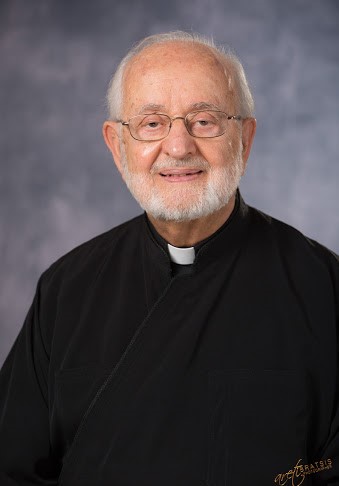
by Fr. Alkiviadis C. Calivas,
Professor Emeritus of Liturgics at Holy Cross Greek Orthodox School of Theology in Brookline, MA
Liturgical spoons existed from at least the sixth-seventh century.[1] But it does not mean that they were used for Communion. In fact, canon 101 of the Penthekte Synod (691-692) prohibits the use of any receptacle for the reception of the consecrated Bread other than the human hand.[2] The canon reads: “So that if anyone should wish to partake of the pure Body during the time of the synaxis…let him form his hands into the shape of a cross, and thus approaching, let him receive the communion of grace…For we nowise welcome those men who make certain receptacles out of gold or any other material to serve instead of their hands for the reception of the divine gift.”[3]
Before the eleventh/twelfth century everyone, clergy and people alike, received the Holy Gifts separately, in the manner the clergy do to this day. When the people approached, they extended their hands, right over left with palms open, on which the priest placed a portion of the holy Bread. After consuming the Bread, the communicants were offered the Cup by the deacon.[4]
The first clear evidence for the use of communion spoons appeared in the eleventh and twelfth centuries. As we learn from the noted canonist Theodore Balsamon (+ca. 1195), the common spoon had become the established norm in many places by the mid-twelfth century. Commenting on canon 101 of the Penthekte Synod, he complained that the traditional way of distributing Communion was being abandoned in some areas.[5]
Centuries later, in a comment on the same canon, St. Nikodemos (+1809) suggests that the introduction of the communion spoon came about as a result of the scarcity of deacons. By the late twelfth century many churches were served by a single priest, which made the administration of the eucharistic elements separately both awkward and difficult. The problem was solved with the introduction of the spoon. The priest was now able to offer the eucharistic elements together in a spoon. In addition, St. Nikodemos tells us that the placement of the holy Gifts directly into the mouth of communicants helped to curb abuses and avoid spillage when drinking from the Cup. Evidently, some people were careless and dropped particles of the Holy Bread. Others hid it and “used it for wicked purposes.”[6]
The use of the communion spoon was not enacted by a synod, ecumenical or local. Its use came about gradually. Initially, the spoon may have been used to commune the sick and the dying. At first, as one would expect, its use in the Liturgy met with some resistance, as any significant liturgical innovation would. Replacing the centuries old manner of receiving the consecrated Gifts separately, based on the biblical model, was not easy. However, new pastoral needs made the use of the spoon inevitable. In the final analysis, the spoon was accepted, even reluctantly, because it did not violate, contradict, or compromise any doctrinal teachings.
The method by which Communion is administered is purely functional. It serves a practical purpose. Thus, as warranted by needs and circumstances, a local Church in its collective wisdom and authority is free to adapt, modify, and manage the method by which Holy Communion is distributed. Whatever method a Church chooses, the single most important concern is that it does not violate any dogmas and that it is appropriate; that it upholds and maintains the dignity of the sacred act of communing.
We learn from St. Nikodemos that during plagues priests were known to use arbitrary methods to administer communion to the sick and dying.[7] In a comment on canon 28 of the Penthekte Synod, he chides the clergy for using unsuitable methods to deliver Communion to the sick. He recommends a more appropriate method. He writes: “Hence, both priests and prelates must employ some shift in time of a plague to enable them to administer communion to the sick without violating this canon; not, however, by placing the holy Bread in currants, but in some sacred vessel, so that the dying and the sick may take it thence with tongs or the like. The vessel and the tongs are to be placed in vinegar, and the vinegar is to be poured into a funnel, or in any other manner that they can that is safer and canonical.”[8]
St. Nikodemos’ brief note is significant in two ways. First, he insists the vessels used for Communion be sterilized with vinegar, a popular disinfectant from ancient times. This is an acknowledgment that the vessels or instruments used for communing could be contaminated by dangerous parasitic microbes. Second, he insists that the instrument be fitting for the purpose.
In the past forty years several worldwide deadly epidemics, AIDS, SARS, Ebola, and MERS provoked fear among the people. Presently, the world is experiencing another more frightening global threat: the pandemic coronavirus or COVID-19, a contagion with lethal force which has upended all social, economic, political, cultural, and religious norms. People are justly apprehensive and frightened. The disease has already infected millions of people and claimed the lives of thousands globally. As with the preceding epidemics, the highly contagious coronavirus has many people wondering and questioning the continued use of a common spoon for Communion.
The real fears, reservations, and apprehensions of the people should not be dismissed with an air of superiority or a call to greater faith, as if the act of communing is void of human considerations and the limitations of the created order. People want to feel safe, listened to, and protected by their Church. They do not want to be exposed to unnecessary risks, nor should they be.
Statements like, “the Eucharist is the Body and Blood of Christ, and the medicine of immortality,” or “the Eucharist is a divine remedy, a divine medicine,” may be true. But they are not sufficient to calm the fears and concerns of the faithful. People are not questioning the sacred character and identity of the Holy Gifts but the reliability of the instrument by which the Gifts are offered to them.
In my sixty-four years in the priesthood, I have consumed the chalice thousands of times after countless Divine Liturgies without fear or hesitation, as every priest does. I am not certain, however, that every faithful parishioner would do the same, if they were asked. My point is this. Holy Communion should be a source of joy, hope and strength for everyone and not a test or measure of one’s faith in God’s providential care (Matt. 4:5-7). St. Paul reminds us that the love of Christ requires that we care for all persons, whatever their situation and be sensitive and responsive to their just needs and concerns for the sake of the Gospel (1 Cor. 9: 19-23).
Orthodox sacramental theology, distinguishes between what is mystical and what is physical. The divine realities in each sacrament are distinct from the material elements by which they are mediated. We believe and confess that the eucharistic Gifts—the bread and wine—are changed into the Body and Blood of Christ through the prayer of the Church and the power and operation of the Holy Spirit. The change, however, is mystical and not physical. The bread and wine preserve their natural properties and qualities and are bound to the natural laws of their kind.[9] The mode by which the transformation of the Gifts takes place remains a profound mystery. But we know by faith that the change occurs, so that Christ may become our food in order to impart his life to us (John 6:56).
The communion spoon is an imperfect material object. It does not share in the incorruptibility of the risen and deified Body of Christ which is really present to us through the eucharistic elements. On its own, the spoon is simply a spoon, a utensil. Its dignity is derived from its use as the instrument by which the Body and Blood of Christ is offered to his people. Long ago, it replaced an older venerable form of communing. The use of a spoon to commune the people was an innovation.
Today, the very thought of replacing the common spoon has caused great anxiety in some circles. There are those among the clergy and the laity who see the replacement of the common spoon or any other kind of departure from the current practice as a repudiation of the doctrine of the real presence of Christ in the Eucharist. Of course, this is not true.
In response to the present deadly pandemic, three local Churches have already instituted changes in the manner by which Holy Communion is distributed.[10] Circumstances require that every local Church study the issue carefully taking into consideration the cultural and hygienic sensibilities of the people and the sanitary measures and protocols of their respective countries.
The Church of Russia has introduced a small but significant change in the traditional manner of administering Communion, which appears to be based on the model suggested by St. Nikodemos. The common communion spoon is dipped in alcohol and wiped clean after each communicant. The Church of Romania allows the people to bring their own spoon from home. In Ukraine Communion is distributed via intinction—a portion of the Bread is dipped in the chalice and placed by the priest in the hand of the communicant.
In addition to these, several other models have been proposed. Some who wish to retain the common spoon believe it is sufficient to teach the communicants to tilt their head back and open their mouth wide, so that the priest may drop or pour the sacred elements into the mouth of the recipient. The aim of this method is to avoid touching the communicant’s mouth and lips. However, this model is not fail-safe; it does not guarantee the desired outcome. Another suggestion, close to the Romanian model, allows each family to bring its own “family communion spoon” which will be used to commune family members only. This model, however, runs counter to the spirit of canon 101 of the Penthekte Synod which prohibits the use of private vessels for fear that they would lead to social distinctions and the like. Communion, as is well known, is both a personal and a communal act. “Unite us all to one another who become partakers of the one Bread and the Cup” (Anaphora of St. Basil). The Ukrainian model, Communion by intinction, has found support in some quarters. It is a version of the ancient practice. However, it is difficult to manage on several counts, the most obvious being communing the elderly, persons with disabilities, and children.
Another model calls for the replacement of the common spoon with multiple individual spoons; spoons made from common material and are of equal value, which each local parish provides. According to this model, each parish will obtain (perhaps from a common source) a sufficient number of disposable spoons made of plastic or wood. Once used, each spoon would be collected and properly discarded (burned or buried) after each Liturgy.
Or, each parish procures a sufficient number of reusable metal spoons, all of the same type and material. The used spoons are collected and properly sterilized after each Liturgy and are reused multiple times.
Each of these methods shares a common goal: to administer Communion in the safest, most practical, and most dignified way possible. Whatever the model, the fundamental intent is the same: to mitigate the transmission of dangerous parasitic microbes.
Of the several methods, the use of multiple metal reusable spoons seems to be the safest and most practical, and the one closest to the received tradition. The people are used to the spoon.
Also of concern is the common communion cloth, which many people use to wipe their mouth after communing. This practice is problematic and must end. The common cloth should serve only one purpose, to catch any accidental spillage when administering Communion. A group of people, altar servers and/or regular church goers, should be trained to hold the cloth properly as each communicant approaches. The use of personal disposable paper napkins has also been suggested. The napkin is placed in a special basket after each use. To avoid difficulties, the people must be taught on the proper use of the personal napkin.
A change in the manner by which Communion is distributed to the people is unavoidable. It is already happening. The question is whether all the Churches will reach an agreement within the foreseeable future or, will local variations apply until the use of multiple individual metal spoons or some other form becomes the standard? In any event, the change is coming. It is important, therefore, that everyone – clergy and people alike – are properly prepared.
[1] On the history of the communion spoon see Robert F. Taft, “Byzantine Communion Spoons: A Review of the Evidence,” in Dumbarton Oaks Papers (DOP), vol. 50 (1996), 209-238; and Taft, A History of the Liturgy of St. John Chrysostom, vol. VI, The Communion, Thanksgiving, and Concluding Rites, (Rome 2008), 266-306. The early communion spoons (λαβις or κοχλιαριον) were larger and deeper than those we use today.
[2] On the Penthekte Synod and liturgical reforms see Calivas, Aspects of Orthodox Worship (Brookline, MA), 227-234.
[3] Pedalion/Rudder, 408
[4] See. For example, the description in Cyril of Jerusalem, Mystagogical Catechesis, V: 21, 22.
[5] See Rallis and Potlis, Οι Θειοι και Ιεροι Κανονες, (Athens 1853), vol. 2, 548.
[6] Pedalion/Rudder, 410.
[7] To my knowledge, no one has yet undertaken a thorough examination of the historical record to ascertain how the Church handled various pastoral needs—especially the distribution of Communion—in times of major epidemics and other crises which effected societal and ecclesial norms. In such instances, did the long-standing custom of infrequent Communion play a role? Was it a mitigating factor? We know, for example, that in Constantinople and other large cities during the mid-seventeenth century the lengthy burial services enshrined in the Great Euchologion were being abbreviated in order to manage the inordinate number of funerals due to epidemics and the casualties they produced. See Ioannis M. Fountoulis, Τελετουργικα Θέματα (Athens 2002), 157-160. What other changes and concessions has the Church made in times of crises?
[8] Pedalion/Rudder, 322 (note).
[9] This is in keeping with the dogmatic definition of the Fourth Ecumenical Synod of Chalcedon: “Therefore, following the holy fathers, all of us teach unanimously that everyone must confess that our Lord Jesus Christ is one single and same Son, who is perfect according to divinity and perfect according to humanity, truly God and truly man…consubstantial with the Father according to divinity and consubstantial with us according to humanity, completely like us except for sin; He was begotten by then Father before all ages according to his divinity and, in these latter days, He was born for us and our salvation of Mary the Virgin, the Theotokos according to His humanity; one single and same Christ, Son, Lord, only begotten, known in two natures, without confusion, without change, without, division, without separation (ασυγχυτως, ατρεπτως, αδιαιρετως, αχωριστως); the difference of nature is in no way suppressed by their union, but rather the properties of each are retained and united in one single person (προσωπον) and single hypostasis (υποστασις)…” In Archbishop Peter L’Huillier, The Church of the Ancient Councils (Crestwood, NY 1996), 194.
Two examples will illustrate that the natural properties of the bread and wine are retained. Persons who suffer from a severe form of celiac disease, an autoimmune disorder, react badly when they ingest gluten, a protein in wheat, barley, rye and other grains, from which most prosphora are made. These persons often request that they be give the tiniest morsel of the consecrated Bread for fear of a bad reaction. Newly ordained clergy, who are not used to drinking alcoholic beverages, often have difficulty consuming and purifying the Chalice after the Liturgy on an empty stomach. Even more to the point, the reserved sacrament which is traditionally prepared and consecrated every Holy Thursday is handled in a special way. After it has dried thoroughly, it is separated into small pieces and placed under or over fire (heat). This is done to help preserve it.
[10] See the important article by Nicholas Denysenko, “Do Sacraments Prevent Illness?” in Public Orthodoxy, the online publication of the Orthodox Christian studies Center of Fordham University.
Source: GOARCH