

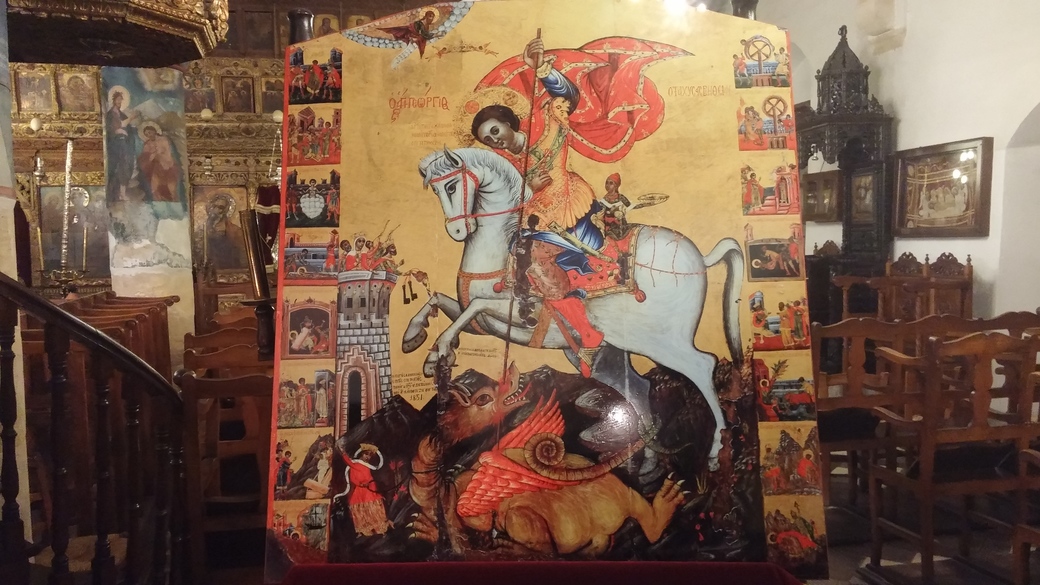
The Holy Great Martyr George the Victory-Bearer, was a native of Cappadocia (a district in Asia Minor), and he grew up in a deeply believing Christian family. His father was martyred for Christ when George was still a child. His mother, owning lands in Palestine, moved there with her son and raised him in strict piety.
When he became a man, Saint George entered into the service of the Roman army. He was handsome, brave and valiant in battle, and he came to the notice of the emperor Diocletian (284-305) and joined the imperial guard with the rank of comites, or military commander.
The pagan emperor, who did much for the restoration of Roman might, was clearly concerned with the danger presented to pagan civilization by the triumph of the Crucified Savior, and intensified his persecution against the Christians in the final years of his reign. Following the advice of the Senate at Nicomedia, Diocletian gave all his governors full freedom in their court proceedings against Christians, and he promised them his full support.
Saint George, when he heard the decision of the emperor, distributed all his wealth to the poor, freed his servants, and then appeared in the Senate. The brave soldier of Christ spoke out openly against the emperor’s designs. He confessed himself a Christian, and appealed to all to acknowledge Christ: “I am a servant of Christ, my God, and trusting in Him, I have come among you voluntarily, to bear witness concerning the Truth.”
“What is Truth?” one of the dignitaries asked, echoing the question of Pontius Pilate. The saint replied, “Christ Himself, Whom you persecuted, is Truth.”
Stunned by the bold speech of the valiant warrior, the emperor, who had loved and promoted George, attempted to persuade him not to throw away his youth and glory and honors, but rather to offer sacrifice to the gods as was the Roman custom. The confessor replied, “Nothing in this inconstant life can weaken my resolve to serve God.”
Then by order of the enraged emperor the armed guards began to push Saint George out of the assembly hall with their spears, and they then led him off to prison. But the deadly steel became soft and it bent, just as the spears touched the saint’s body, and it caused him no harm. In prison they put the martyr’s feet in stocks and placed a heavy stone on his chest.
The next day at the interrogation, powerless but firm of spirit, Saint George again answered the emperor, “You will grow tired of tormenting me sooner than I will tire of being tormented by you.” Then Diocletian gave orders to subject Saint George to some very intense tortures. They tied the Great Martyr to a wheel, beneath which were boards pierced with sharp pieces of iron. As the wheel turned, the sharp edges slashed the saint’s naked body.
At first, the sufferer loudly cried out to the Lord, but soon he quieted down, and did not utter even a single groan. Diocletian decided that the tortured one was already dead, and he gave orders to remove the battered body from the wheel, and then went to a pagan temple to offer thanks.
At this very moment it got dark, thunder boomed, and a voice was heard: “Fear not, George, for I am with you.” Then a wondrous light shone, and at the wheel an angel of the Lord appeared in the form of a radiant youth. He placed his hand upon the martyr, saying to him, “Rejoice!” Saint George stood up healed.
When the soldiers led him to the pagan temple where the emperor was, the emperor could not believe his own eyes and he thought that he saw before him some other man or even a ghost. In confusion and in terror the pagans looked Saint George over carefully, and they became convinced that a miracle had occurred. Many then came to believe in the Life-Creating God of the Christians.
Two illustrious officials, Saints Anatolius and Protoleon, who were secretly Christians, openly confessed Christ. Immediately, without a trial, they were beheaded with the sword by order of the emperor. Also present in the pagan temple was Empress Alexandra, the wife of Diocletian, and she also knew the truth. She was on the point of glorifying Christ, but one of the servants of the emperor took her and led her off to the palace.
The emperor became even more furious. He had not lost all hope of influencing Saint George, so he gave him over to new and fiercesome torments. After throwing him into a deep pit, they covered it over with lime. Three days later they dug him out, but found him cheerful and unharmed. They shod the saint in iron sandals with red-hot nails, and then drove him back to the prison with whips. In the morning, they led him back to the interrogation, cheerful and with healed feet, and the emperor asked if he liked his shoes. The saint said that the sandals had been just his size. Then they beat him with ox thongs until pieces of his flesh came off and his blood soaked the ground, but the brave sufferer, strengthened by the power of God, remained unyielding.
The emperor concluded that the saint was being helped by magic, so he summoned the sorcerer Athanasius to deprive the saint of his miraculous powers, or else poison him. The sorcerer gave Saint George two goblets containing drugs. One of them would have quieted him, and the other would kill him. The drugs had no effect, and the saint continued to denounce the pagan superstitions and glorify God as before.
When the emperor asked what sort of power was helping him, Saint George said, “Do not imagine that it is any human learning which keeps me from being harmed by these torments. I am saved only by calling upon Christ and His Power. Whoever believes in Him has no regard for tortures and is able to do the things that Christ did” (John 14:12). Diocletian asked what sort of things Christ had done. The Martyr replied, “He gave sight to the blind, cleansed the lepers, healed the lame, gave hearing to the deaf, cast out demons, and raised the dead.”
Knowing that they had never been able to resurrect the dead through sorcery, nor by any of the gods known to him, and wanting to test the saint, the emperor commanded him to raise up a dead person before his eyes. The saint retorted, “You wish to tempt me, but my God will work this sign for the salvation of the people who shall see the power of Christ.”
When they led Saint George down to the graveyard, he cried out, “O Lord! Show to those here present, that You are the only God in all the world. Let them know You as the Almighty Lord.” Then the earth quaked, a grave opened, the dead one emerged from it alive. Having seen with their own eyes the Power of Christ, the people wept and glorified the true God.
The sorcerer Athanasius, falling down at the feet of Saint George, confessed Christ as the All-Powerful God and asked forgiveness for his sins, committed in ignorance. The obdurate emperor in his impiety thought otherwise. In a rage, he commanded both Athanasius and the man raised from the dead to be beheaded, and he had Saint George again locked up in prison.
The people, weighed down with their infirmities, began to visit the prison and they there received healing and help from the saint. A certain farmer named Glycerius, whose ox had collapsed, also visited him. The saint consoled him and assured him that God would restore his ox to life. When he saw the ox alive, the farmer began to glorify the God of the Christians throughout all the city. By order of the emperor, Saint Glycerius was arrested and beheaded.
The exploits and the miracles of the Great Martyr George had increased the number of the Christians, therefore Diocletian made a final attempt to compel the saint to offer sacrifice to the idols. They set up a court at the pagan temple of Apollo. On the final night the holy martyr prayed fervently, and as he slept, he saw the Lord, Who raised him up with His hand, and embraced him. The Savior placed a crown on Saint George’s head and said, “Fear not, but have courage, and you will soon come to Me and receive what has been prepared for you.”
In the morning, the emperor offered to make Saint George his co-administrator, second only to himself. The holy martyr with a feigned willingness answered, “Caesar, you should have shown me this mercy from the very beginning, instead of torturing me. Let us go now to the temple and see the gods you worship.”
Diocletian believed that the martyr was accepting his offer, and he followed him to the pagan temple with his retinue and all the people. Everyone was certain that Saint George would offer sacrifice to the gods. The saint went up to the idol, made the Sign of the Cross and addressed it as if it were alive: “Are you the one who wants to receive from me sacrifice befitting God?”
The demon inhabiting the idol cried out, “I am not a god and none of those like me is a god, either. The only God is He Whom you preach. We are fallen angels, and we deceive people because we are jealous.”
Saint George cried out, “How dare you remain here, when I, the servant of the true God, have entered?” Then noises and wailing were heard from the idols, and they fell to the ground and were shattered.
There was general confusion. In a frenzy, pagan priests and many of the crowd seized the holy martyr, tied him up, and began to beat him. They also called for his immediate execution.
The holy empress Alexandra tried to reach him. Pushing her way through the crowd, she cried out, “O God of George, help me, for You Alone are All-Powerful.” At the feet of the Great Martyr the holy empress confessed Christ, Who had humiliated the idols and those who worshipped them.
Diocletian immediately pronounced the death sentence on the Great Martyr George and the holy Empress Alexandra, who followed Saint George to execution without resisting. Along the way she felt faint and slumped against a wall. There she surrendered her soul to God.
Saint George gave thanks to God and prayed that he would also end his life in a worthy manner. At the place of execution the saint prayed that the Lord would forgive the torturers who acted in ignorance, and that He would lead them to the knowledge of Truth. Calmly and bravely, the holy Great Martyr George bent his neck beneath the sword, receiving the crown of martyrdom on April 23, 303.
The pagan era was coming to an end, and Christianity was about to triumph. Within ten years, Saint Constantine (May 21) would issue the Edict of Milan, granting religious freedom to Christians.
Of the many miracles worked by the holy Great Martyr George, the most famous are depicted in iconography. In the saint’s native city of Beirut were many idol-worshippers. Outside the city, near Mount Lebanon, was a large lake, inhabited by an enormous dragon-like serpent. Coming out of the lake, it devoured people, and there was nothing anyone could do, since the breath from its nostrils poisoned the very air.
On the advice of the demons inhabiting the idols, the local ruler came to a decision. Each day the people would draw lots to feed their own children to the serpent, and he promised to sacrifice his only daughter when his turn came. That time did come, and the ruler dressed her in her finest attire, then sent her off to the lake. The girl wept bitterly, awaiting her death. Unexpectedly for her, Saint George rode up on his horse with spear in hand. The girl implored him not to leave her, lest she perish.
The saint signed himself with the Sign of the Cross. He rushed at the serpent saying, “In the Name of the Father and of the Son and of the Holy Spirit.” Saint George pierced the throat of the serpent with his spear and trampled it with his horse. Then he told the girl to bind the serpent with her sash, and lead it into the city like a dog on a leash.
The people fled in terror, but the saint halted them with the words: “Don’t be afraid, but trust in the Lord Jesus Christ and believe in Him, since it is He Who sent me to save you.” Then the saint killed the serpent with a sword, and the people burned it outside the city. Twenty-five thousand men, not counting women and children, were then baptized. Later, a church was built and dedicated to the Most Holy Theotokos and the Great Martyr George.
Saint George went on to become a talented officer and to amaze the world by his military exploits. He died before he was thirty years old. He is known as Victory Bearer, not only for his military achievements, but for successfully enduring martyrdom. As we know, the martyrs are commemorated in the dismissal at the end of Church services as “the holy, right victorious martyr….”
Saint George was the patron saint and protector of several of the great builders of the Russian state. Saint Vladimir’s son, Yaroslav the Wise (in holy Baptism George), advanced the veneration of the saint in the Russian Church. He built the city of Yuriev [i.e., “of Yurii.” “Yurii” is the diminutive of “George”, as “Ivan” is of “John”], he also founded the Yuriev monastery at Novgorod, and he built a church of Saint George the Victory Bearer at Kiev.
The day of the consecration of Saint George’s Church in Kiev, November 26, 1051 by Saint Hilarion, Metropolitan of Kiev and All Rus, has entered into the liturgical treasury of the Church as a special church feastday. Yuriev Day is beloved by the Russian people as an “autumn Feast of Saint George.”
The name of Saint George was also borne by the founder of Moscow, Yurii Dolgoruky (+ 1157), who was the builder of many churches dedicated to Saint George, and the builder of the city of Yuriev-Polsk. In the year 1238 the heroic fight of the Russian nation against the Mongol Horde was led by the Great Prince Yurii (George) Vsevolodovich of Vladimir (February 4), who fell at the Battle at the Sita River. His memory, like that of Igor the Brave, and defender of his land, was celebrated in Russian spiritual poems and ballads.
The first Great Prince of Moscow, when Moscow had become the center of the Russian Land, was Yurii Danilovich (+ 1325), the son of Saint Daniel of Moscow, and grandson of Saint Alexander Nevsky. From that time Saint George the Victory Bearer, depicted as a horseman slaying the serpent, appeared on Moscow’s coat of arms, and became an emblem of the Russian state. This has strengthened Russia’s connections with Christian nations, and especially with Iberia (Georgia, the Land of Saint George).
Source: basilica.ro