
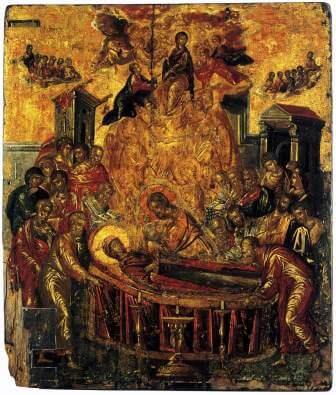
The Dormition of the Theotokos is one of the Great Feasts of the Orthodox Church, celebrated on August 15. The word “Dormition” is a derivative from the Latin word “dormitio”, which means “falling asleep.”
The Feast of the Dormition of the Theotokos is the commemoration of the falling asleep, burial, resurrection, and translation of the Theotokos into heaven in the body.
Historical Background of the Feast
The Feast of the Dormition of the Theotokos is one of the oldest Marian feasts in the church. The roots of the feast go back to Jerusalem, where the apostles and the Christians of Jerusalem honored and kept alive the memory of the falling asleep of the Theotokos. Consequently, quickly, her empty tomb, in Gethsemane, became a destination for pilgrims from Jerusalem and the surrounding neighborhoods.
After the dogmatization of the doctrine of the Divine Motherhood of the Virgin Mary in the third Ecumenical Council of Ephesus (431), the commemoration of the falling asleep of the Theotokos became more popular amongst Christians in the vast majority of the Christian world.
In the late sixth century, in the year 588, the Emperor Maurice officially adopted the commemoration of the Feast of the Dormition of the Theotokos into the liturgical calendar in the entire Byzantine Empire, and commanded that it be celebrated on August 15.
In the second half of the seventh century, the feast of the Dormition appeared in the West under the influence of the East. It was accepted in Rome under Pope Sergius I (687701), and from Rome it passed over to the rest of Europe.
Up until the end of the ninth century, the feast of the Dormition of the Theotokos was preceded by two periods of fasting: FIRST: before the feast of the Transfiguration (August 1-5) and SECOND: after the feast of the Transfiguration (August 7-15). In the tenth century, the two fasting periods were merged into one, which includes fourteen fasting days beginning on August 1st through August 14th.
The Narrative of the Feast
The main source of the narrative of the feast of the Dormition is based on the oral and written Tradition of the church, which include: the writings of Saints Dionysios the Areopagite, John the Damascene and Andrew of Crete; the hymnography and iconography of the Church, in addition to an apocryphal narrative of the feast by Saint John the Theologian.
According to the Orthodox Tradition, the Virgin Mary lived after Pentecost in the house of the Apostle John in Jerusalem. As the Mother of the Lord, she became the source of encouragement and help for the Apostles and all Christians.
Three days before her death, the Archangel Gabriel appeared to the Virgin Mary and revealed to her the date of her departure into eternal life. Immediately, the Theotokos returned to her home and prepared herself for this event through fasting and prayer.
On the day of her repose, even though the apostles were scattered throughout the world, they were miraculously transported to be at her side. Exceptionally, the Apostle Thomas did not arrive on time to bid his final farewell to the Theotokos.
While the Apostles were singing hymns in honor of the Mother of God, they saw a vision showing Christ, accompanied by Angels and Saints, coming to escort the soul of His Most Holy Mother into heaven. With songs of praises, the Apostles carried the body of the most pure Theotokos to the grave in Gethsemane to be buried near her parents.
At Gethsemane, the disciples gathered and remained around her tomb and kept a vigil for three days. On the Third day, the Apostle Thomas arrived and asked to view for the last time the Most Holy Mother of God. When the Apostles opened the grave of the Theotokos, her body was not there. The Apostles realized then that she was taken into heaven in the body to be reunited with her soul.
The Liturgical Background of the Feast
The Feast of the Dormition of the Theotokos is preceded by a two-week fasting period, which referred to as the “Dormition Fast.” The Dormition Fast starts on August 1 and ends on August 14th. It is considered to be a very strict fast, even stricter than both the Nativity and the Apostles Fasts.
In the Dormition Fast all kinds of meat, fish, oil and wine are forbidden to eat; with the following exceptions: on the feast of the Transfiguration (August 6) when fish is allowed; on Saturdays and Sundays when oil and wine are allowed.
During the Dormition Fast, either the Small Paraklesis (Supplicatory Canon) or the Great Paraklesis are celebrated every evening with the following exceptions: on Saturdays, on the Eve of the Feast of the Transfiguration and on the Eve of the Feast of the Dormition itself, where the festal services are celebrated.
In some churches and monasteries, the service of the “Burial of the Theotokos” is celebrated during an All-Night Vigil. The order of the service is based on the service of the burial of Christ, which consists of chanting the “Lamentations at the Bier of the Mother of God”, and a solemn procession made with the a Epitaphion of the Theotokos.
According to our Antiochian practice, the Lamentations of the Dormition of the Theotokos may be chanted at Great Vespers on the eve of the Feast. Please note that this beautiful service of the “Burial of the Theotokos” is not a standard service in most parishes, or even most cathedrals or monasteries.
The Meaning of the Feast
The hymnography and liturgical text of the feast of the Dormition portrays the feast as mystical, eschatological, and paschal in nature.
1. Mystical and Eschatological
The hymnography of the feast envisions the Dormition of the Theotokos as an eschatological event that confirms the destruction of hades and the defeat of death. The Dormition of the Theotokos confirms the reality of the transformation of death from a fearful enemy into a joyous passage to eternal life.
The eschatological nature of the feast of the Dormition is evident, not only in the hymnography of the feast, but also in the mysterious gathering of the apostles, who gathered to witness how Christ, himself, comes to escort His mother to the kingdom. They are mysteriously gathered to witness, again, to the truthfulness of resurrection of Christ and his victory over death.
2. Paschal
The liturgical text of the Feast of the Dormition depicts the feast as a Paschal event. The hymns of the feast assert that the Virgin Mary experienced her own personal Pascha by passing through death and rising to eternal life. Being alive in heaven, as a queen and mother of Christ, we, now, can ask her intercessions to help us transform our own forthcoming death into a Paschal victory over death.
In the ecclesiastical tradition, the feast of Dormition of the Theotokos is called the “Summer Pascha.” This name is derived from the fact that the Theotokos experienced her own Pascha; “Passover” from this life into life eternal.
St. John of Damascus confirms the Paschal nature of the Feast of the Dormition by calling the death of the Theotokos: “The Deathless Death”. He calls it the deathless death because of the fact that death resulted in her translation into life eternal, into glorification and union with the Lord. “O how does the source of life pass through death to life? She dies according to the flesh, destroys death by death, and through corruption gains incorruption, and makes her death the source of resurrection.” (St. John of Damascus)
Conclusion
The Dormition of the Theotokos is a confirmation of the resurrection of Christ and a source of hope for the faithful in the promise of their personal resurrection, their personal Pascha. The death of the Theotokos and her translation into heaven confirms the divine promise of Christ to His faithful children that they will enjoy life eternal in everlasting communion with God.
What a paradox! While this Feast is called the “Falling Asleep of the Theotokos,” it is in reality a celebration of her life and victory over death. It is a celebration of her “Passover” from this life into life eternal. It is a celebration of the confirmation of the promise of our own resurrection in Christ. Amen!
Source: Orthodox Metropolis of Zambia