

• About
  • Advertise
  • Contact
Monday, August 10, 2026
No Result
View All Result
NEWSLETTER
Orthodox Times (en)
  • Home
  • Orthodoxy
    • Ecumenical Patriarchate
      • Dioceses of the Ecumenical Patriarchate
      • Mount Athos
      • Archdiocese of America
      • Archdiocese of Australia
      • Church of Crete
    • Patriarchates
      • Patriarchate of Alexandria
      • Patriarchate of Antioch
      • Patriarchate of Moscow
      • Patriarchate of Serbia
      • Patriarchate of Romania
      • Patriarchate of Jerusalem
      • Patriarchate of Bulgaria
      • Patriarchate of Georgia
    • Churches
      • Church of Greece
      • Church of Cyprus
      • Church of Poland
      • Church of Albania
      • Church of Czech and Slovakia
      • Church of Ukraine
  • Politics
    • USA
    • Europe
    • Middle East
  • Society
    • Greek Diaspora
    • Culture
  • Spirituality
  • Christianity
  • Opinions
  • Home
  • Orthodoxy
    • Ecumenical Patriarchate
      • Dioceses of the Ecumenical Patriarchate
      • Mount Athos
      • Archdiocese of America
      • Archdiocese of Australia
      • Church of Crete
    • Patriarchates
      • Patriarchate of Alexandria
      • Patriarchate of Antioch
      • Patriarchate of Moscow
      • Patriarchate of Serbia
      • Patriarchate of Romania
      • Patriarchate of Jerusalem
      • Patriarchate of Bulgaria
      • Patriarchate of Georgia
    • Churches
      • Church of Greece
      • Church of Cyprus
      • Church of Poland
      • Church of Albania
      • Church of Czech and Slovakia
      • Church of Ukraine
  • Politics
    • USA
    • Europe
    • Middle East
  • Society
    • Greek Diaspora
    • Culture
  • Spirituality
  • Christianity
  • Opinions
No Result
View All Result
Orthodox Times (en)
No Result
View All Result

Patriarch Daniel: The Church has promoted the Romanian people’s unity, freedom and dignity

Jan 29, 2020 | 11:30
in Carousel Front Page, Patriarchate of Romania
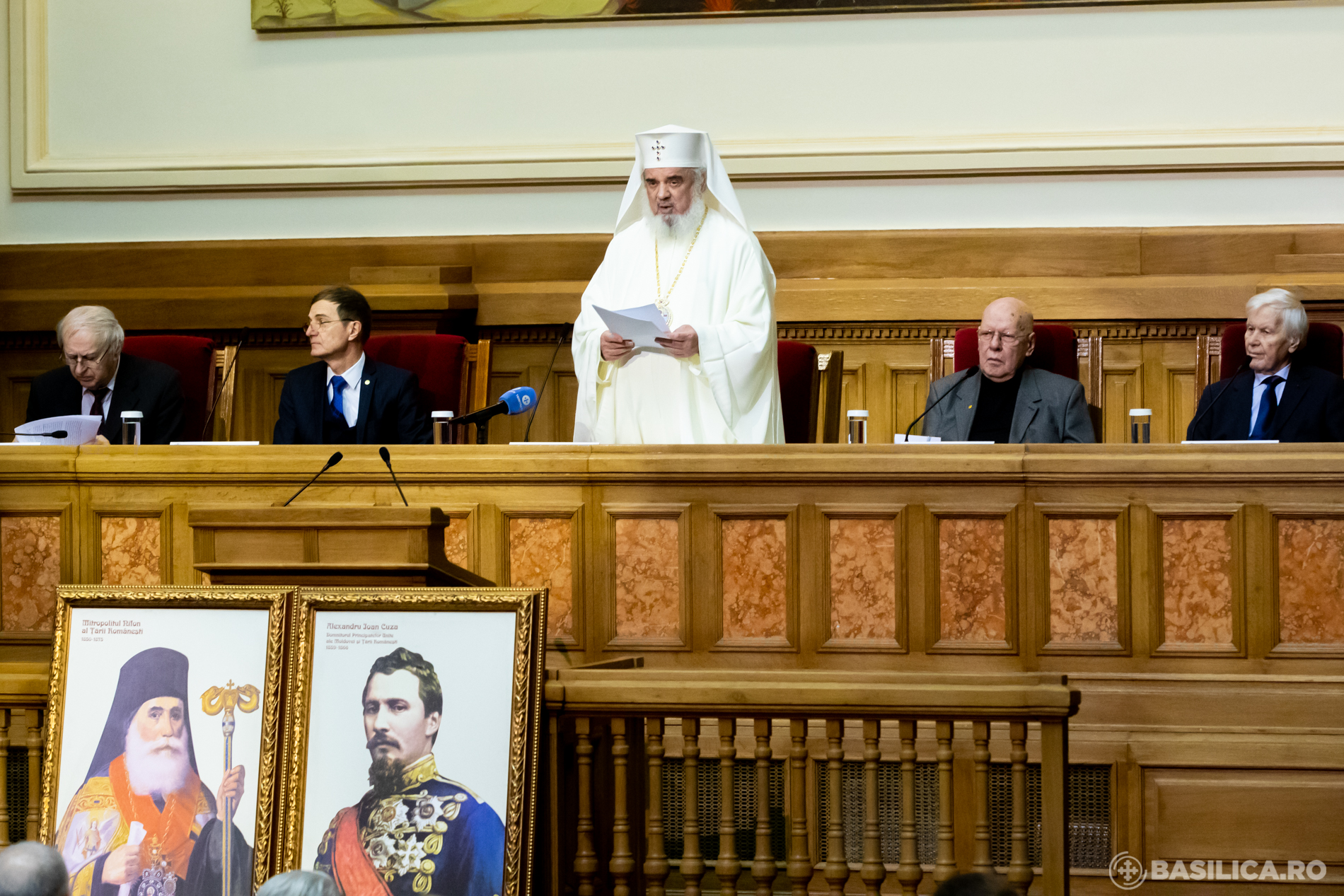
Patriarch Daniel: The Church has promoted the Romanian people’s unity, freedom and dignity

© Basilica.ro / Mircea Florescu

Patriarch Daniel stressed that the Church has promoted the unity, freedom and dignity of the Romanian people during a joint session held by the Romanian Patriarchate and the Romanian Academy at the Patriarchate’s Palace last Thursday.

Addressing those present, the Patriarch of Romania pointed out the involvement of the Church leaders in the achievement of the 1859 Union of the Romanian Principalities of Wallachia and Moldavia.

The Union meant ‘the crowning of an entire process of national awakening and crystallization of the idea of nation, a process in which the Church made an essential contribution,’ Patriarch Daniel said Jan. 23.

‘The Union of the Romanian Principalities was supported by numerous representatives of the Church: through her hierarchs and through the most enlightened priests and monks, through abbots, seminary professors, deans, theologians etc.’

The patriarch recalled that the most important supporters of the Union included Metropolitans Nifon Rusailă of Wallachia and Sofronie Miclescu of Moldova, as well as Archimandrites Melchisedec Stefannescu and Neofit Scriban.

‘The Union of the Romanian Principalities also implied the unitary organization of the church structures in all the Romanian provinces, under the leadership of the Holy Synod of the Romanian Orthodox Church, confirmed by Alexandru Ioan Cuza through the 1864 Law.’

‘At the same time,’ Patriarch Daniel said, ‘Prince Alexandru Ioan Cuza, together with the hierarchs of the Holy Synod of the Church in the Romanian Principalities, made several requests to the Ecumenical Patriarchate to obtain the recognition of the autocephaly of the Romanian Orthodox Church.’

‘On December 3, 1864, the Organic Decree for the establishment of a central synodal authority for the affairs of the Romanian religion was promulgated, which stipulated, in the first article, that “the Romanian Orthodox Church is and remains independent of any foreign church authority, as far as organization and discipline are concerned,” the patriarch said quoting the Official Journal of Romania from 6/19 December 1864.

‘It was the first step towards autocephaly. For the first time in the history of the Romanian Principalities, a text of law officially provided the independence of the Romanian Orthodox Church,’ Patriarch Daniel explained.

‘On February 11, 1866, as is known, Prince Alexandru Ioan Cuza was forced to leave his throne. But the struggle for the attainment of autocephaly of the Romanian Orthodox Church continued and it was clearly expressed in Article 21 of the Romanian State Constitution, promulgated on June 30, 1866, by Prince Carol I (1866-1914), stating that “the Romanian Orthodox Church is and remains independent of any foreign hierarchy, however, maintaining its unity with the Ecumenical Church of the East regarding dogmas” and it has “a central synodal authority for regulating canonical and disciplinary matters”.’

“On December 14, 1872, the Organic Law of the Romanian Orthodox Church was promulgated, which provided the autocephaly of the Romanian Orthodox Church and which provided to establish the Holy Synod, meant to preserve the dogmatic and canonical unity with the Eastern Church, as well as the administrative and disciplinary unity of the national Church,” Patriarch Daniel highlighted.

‘At the same time, the law conferred on the Metropolitan of Wallachia the honorary title of Primate Metropolitan of Romania, being also of fact and law the chairman of the Holy Synod. This law was then followed by a series of regulations designed to ensure the position of independence of our Church.’

After Romania gained its state independence in 1877 and was declared a Kingdom in 1881, ‘the prestige of the Romanian Orthodox Church increased, making necessary the formal recognition of its autocephaly, long denied by the Ecumenical Patriarchate.’

‘On November 23, 1882, the Holy Synod of the Orthodox Church of the Kingdom of Romania assumed a “Synodal Act”, vested with the signatures of all the hierarchs of the country and with the seal of the Synod, which supported with historical and theological arguments the need for the recognition of the autocephaly of the Romanian Orthodox Church.’

Patriarch Daniel explained that this Synodal Act reviewed the relations between the Christian Church on the Romanian land and the Ecumenical Patriarchate, mentioning the establishment of the metropolises in the Romanian Principalities and underscoring how Romanians have always defended their church autonomy against the arbitrary attempts of Constantinople.

“The Constantinople Patriarchate has no supremacy over the Romanian Church, Romanians did not receive the baptism or the Christian teaching from Constantinople, nor their first bishops. The Christianity of Romanians is older than the very existence of Constantinople,” a city inaugurated in 330 by Emperor Constantine the Great.

‘However, only after 26 years after the Union of the Romanian Principalities, on April 25, 1885, the Ecumenical Patriarch Joachim IV (1884-1886), who was more open to negotiations with the church hierarchy and the authorities of the Romanian state, sent to Bucharest the Tomos of Autocephaly of the Romanian Orthodox Church.’

‘The Tomos notes that the recognition of the autocephaly of the Romanian Orthodox Church also means the recognition of its canonical authority, equal to the canonical authority of the other sister Churches. Therefore, the Synod of the Autocephalous Romanian Orthodox Church is called “Fellow Synod in Christ”.’

‘The supreme authority responsible for the administration or management of an autocephalous Church is its Holy Synod, presided over by an archbishop, metropolitan or patriarch.’

‘The Holy Synod of this Church is not subordinate to another ecclesial authority, but, the Holy Synod of an autocephalous Church must exercise this total freedom of church leadership, having the awareness of direct responsibility before Christ, the Head of the Church and the Eternal High Priest, as stated in the Tomos.’

‘Therefore, we can say that the independence or autocephaly of the Romanian Orthodox Church to any outside church authority has existed since ancient times, as other Orthodox Churches had a de facto autocephaly in certain historical epochs, but this autocephaly was not officially recognized by the Ecumenical Patriarchate.’

‘In the 19th century, the autocephaly was first officially proclaimed by a decree of the state authority on December 3, 1864, then by the church authority in 1872, when the Holy Canonical Synod of the Romanian Orthodox Church was established.’

‘Therefore, the Ecumenical Patriarchate was placed before a fait accompli, and the act of recognition of the autocephaly of April 25, 1885, was a formal act, a recognition of a factual state that had existed for a long time. In Transylvania, the autocephaly of the Romanian Orthodox Church has been expressed by the Organic Statute of Metropolitan Andrew Şaguna in 1868.’

‘Thus, the Church of Orthodox Romanians from the Romanian Principalities has enjoyed, from the beginning of the political organization of the Romanian states, administrative freedom equal to autocephaly.’

‘Based on the natural geographical, ethnic and historical-political conditions in which they operated, the Metropolises of the Romanian Principalities were, in fact, autocephalous churches, established on a national basis, but maintaining dogmatic, canonical and religious ties with the Ecumenical Patriarchate and all the other Sister Orthodox Churches.’

The Patriarch concluded his speech by recalling that this year we mark 135 years since the Ecumenical Patriarchate of Constantinople recognized ‘after long and difficult discussions’ the autocephaly of the Romanian Orthodox Church, and 95 years since the bestowal of the rank of Patriarchate in 1925.

‘In conclusion, the official recognition of the autocephaly of the Romanian Orthodox Church was possible only after the Union of the Romanian Principalities in 1859, the Independence of Romania in 1877 and the proclamation of Romania as Kingdom in 1881, while the elevation of the Romanian Orthodox Church to the rank of Patriarchate in 1925 was possible only after the Great Union of all Romanians in 1918.’

‘Through all these efforts of the Romanian State and of our Church, the freedom, unity and dignity of the Romanian people were affirmed,’ Patriarch Daniel highlighted.

Source: basilica.ro

Tags: Patriarch Daniel of RomaniaPatriarchate of Romania

Follow OrthodoxTimes.com on Google News and learn all the news about Orthodoxy in Greece and worldwide.

All the latest developments in the Orthodox world, society and humankind, at the moment they happen, at OrthodoxTimes.com


Related Posts

Patriarch of Romania: Strong faith, persistent prayer, and complete fasting drive out demons
Patriarchate of Romania

Patriarch of Romania: Strong faith, persistent prayer, and complete fasting drive out demons

August 9, 2026
Patriarch of Romania: The Transfiguration shows humanity’s destiny is heaven, not the grave
Patriarchate of Romania

Patriarch of Romania: The Transfiguration shows humanity’s destiny is heaven, not the grave

August 8, 2026
Patriarch of Romania: Only Christ can save the Church amid the storms of history
Patriarchate of Romania

Patriarch of Romania: Only Christ can save the Church amid the storms of history

August 2, 2026
Romanian Patriarchate supports Athonite Monasteries with books and humanitarian aid
Patriarchate of Romania

Romanian Patriarchate calls on Parishes and Monasteries to support people during extreme heat

July 31, 2026
Metropolis of Bessarabia marks 24 years since official recognition in Moldova
Patriarchate of Romania

Metropolis of Bessarabia marks 24 years since official recognition in Moldova

July 31, 2026
The Ambassador of Romania to Italy received the Patriarchal Distinction “Saint Lady Maria Brâncoveanu”
Patriarchate of Romania

The Ambassador of Romania to Italy received the Patriarchal Distinction “Saint Lady Maria Brâncoveanu”

July 31, 2026
Load More
Next Post
Saint Sava’s Day was celebrated in Memorial Cathedral of Serbian people in Vracar district

Saint Sava's Day was celebrated in Memorial Cathedral of Serbian people in Vracar district

Latest News

Metropolitan Arsenios of Austria: True Faith means surrendering our will to God

Metropolitan Arsenios of Austria: True Faith means surrendering our will to God

by NewsRoom
Aug 10, 2026 | 16:15
0

Metropolitan Arsenios of Austria presided over the Hierarchical Divine Liturgy on Sunday, August 9, 2026, at the Church of...

Metropolitan of Kyiv: Ukraine’s energy workers serve on another front line of the war

Metropolitan Epifaniy: Let us not attribute to hierarchs authority that belongs only to Christ

by NewsRoom
Aug 10, 2026 | 13:09
0

Metropolitan Epifaniy of Kyiv and All Ukraine reflected on the importance of preserving the unity of the Church and...

Bulgarian Church warns of AI-generated video falsely featuring Metropolitan Gabriel

Bulgarian Church warns of AI-generated video falsely featuring Metropolitan Gabriel

by NewsRoom
Aug 10, 2026 | 12:51
0

The Bulgarian Orthodox Church has warned the public about a manipulated video circulating online in which artificial intelligence was...

Cyprus reaffirms support for Orthodox Church’s pastoral work in Jordan

Cyprus reaffirms support for Orthodox Church’s pastoral work in Jordan

by NewsRoom
Aug 10, 2026 | 11:50
0

The Special Representative of the President of the Republic of Cyprus for Religious Freedoms and the Protection of Minorities...

Patriarch of Bulgaria: God’s Grace transforms and purifies the human heart

Patriarch of Bulgaria: God’s Grace transforms and purifies the human heart

by NewsRoom
Aug 10, 2026 | 11:48
0

Bulgarian Patriarch Daniel presided over the Divine Liturgy on Sunday, August 9, at the historic Church of the Dormition...

Memory of Martyr and Archdeacon Laurence, and those with him, of Rome (10 August)

Memory of Martyr and Archdeacon Laurence, and those with him, of Rome (10 August)

by NewsRoom
Aug 10, 2026 | 11:42
0

The Martyrs Archdeacon Laurence, Pope Sixtus, Deacons Felicissimus and Agapitus, and the soldier Romanus were citizens of Rome, and...

Newsletter

Sign up for our weekly newsletter


Quick Links

  • Orthodoxy
  • Politics
  • Society
  • Spirituality
  • Christianity
  • Opinions
  • History
  • Press Releases

Get Social

About Us

Advertise

Contact

Terms Of Use

© 2026 OrthodoxTimes.com
digital world media

No Result
View All Result
  • Home
  • Orthodoxy
    • Ecumenical Patriarchate
      • Dioceses of the Ecumenical Patriarchate
      • Mount Athos
      • Archdiocese of America
      • Archdiocese of Australia
      • Church of Crete
    • Patriarchates
      • Patriarchate of Alexandria
      • Patriarchate of Antioch
      • Patriarchate of Moscow
      • Patriarchate of Serbia
      • Patriarchate of Romania
      • Patriarchate of Jerusalem
      • Patriarchate of Bulgaria
      • Patriarchate of Georgia
    • Churches
      • Church of Greece
      • Church of Cyprus
      • Church of Poland
      • Church of Albania
      • Church of Czech and Slovakia
      • Church of Ukraine
  • Politics
    • USA
    • Europe
    • Middle East
  • Society
    • Greek Diaspora
    • Culture
  • Spirituality
  • Christianity
  • Opinions
  • Greek Version

© 2023 OrthodoxTimes.com - All rights reserved.

This website uses cookies to improve your experience. We'll assume you're ok with this, but you can opt-out if you wish.AcceptReject Read More
Privacy & Cookies Policy

Privacy Overview

This website uses cookies to improve your experience while you navigate through the website. Out of these, the cookies that are categorized as necessary are stored on your browser as they are essential for the working of basic functionalities of the website. We also use third-party cookies that help us analyze and understand how you use this website. These cookies will be stored in your browser only with your consent. You also have the option to opt-out of these cookies. But opting out of some of these cookies may affect your browsing experience.
Necessary
Always Enabled

Necessary cookies are absolutely essential for the website to function properly. This category only includes cookies that ensures basic functionalities and security features of the website. These cookies do not store any personal information.

Non-necessary

Any cookies that may not be particularly necessary for the website to function and is used specifically to collect user personal data via analytics, ads, other embedded contents are termed as non-necessary cookies. It is mandatory to procure user consent prior to running these cookies on your website.

SAVE & ACCEPT