
On the Sunday before the Feast of Great and Holy Pascha and at the beginning of Holy Week, the Orthodox Church celebrates one of its most joyous feasts of the year.
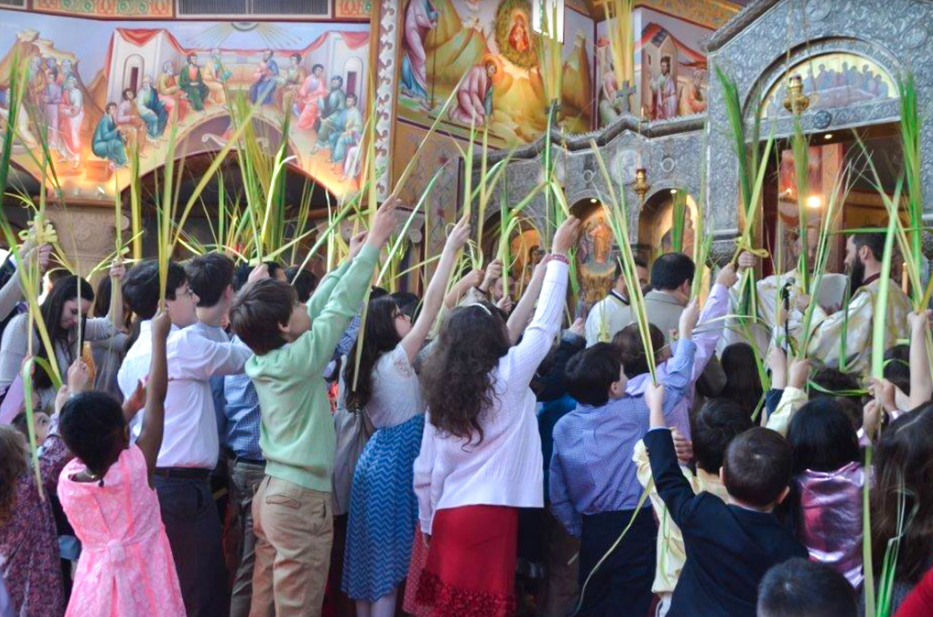
Palm Sunday is the commemoration of the Entrance of our Lord into Jerusalem following His glorious miracle of raising Lazarus from the dead. Having anticipated His arrival and having heard of the miracle, the people went out to meet the Lord and welcomed Him with displays of honour and shouts of praise. On this day, we receive and worship Christ in this same manner, acknowledging Him as our King and Lord.
Biblical Story
The biblical story of Palm Sunday is recorded in all four of the Gospels (Matthew 21:1-11; Mark 11:1-10; Luke 19:28-38; and John 12:12-18). Five days before the Passover, Jesus came from Bethany to Jerusalem. Having sent two of His disciples to bring Him a colt of a donkey, Jesus sat upon it and entered the city.
People had gathered in Jerusalem for the Passover and were looking for Jesus, both because of His great works and teaching and because they had heard of the miracle of the resurrection of Lazarus. When they heard that Christ was entering the city, they went out to meet Him with palm branches, laying their garments on the ground before Him, and shouting, “Hosanna! Blessed is he that comes in the Name of the Lord, the King of Israel!”
At the outset of His public ministry, Jesus proclaimed the kingdom of God and announced that the powers of the age to come were already active in the present age (Luke 7:18-22). His words and mighty works were performed “to produce repentance as the response to His call, a call to an inward change of mind and heart which would result in concrete changes in one’s life, a call to follow Him and accept His messianic destiny. The triumphant entry of Jesus into Jerusalem is a messianic event, through which His divine authority was declared.
Palm Sunday summons us to behold our king: the Word of God made flesh. We are called to behold Him not simply as the One who came to us once riding on a colt, but as the One who is always present in His Church, coming ceaselessly to us in power and glory at every Eucharist, in every prayer and sacrament, and in every act of love, kindness and mercy. He comes to free us from all our fears and insecurities, “to take solemn possession of our soul, and to be enthroned in our heart,” as someone has said. He comes not only to deliver us from our deaths by His death and Resurrection but also to make us capable of attaining the most perfect fellowship or union with Him. He is the King, who liberates us from the darkness of sin and the bondage of death. Palm Sunday summons us to behold our King: the vanquisher of death and the giver of life.
Palm Sunday summons us to accept both the rule and the kingdom of God as the goal and content of our Christian life. We draw our identity from Christ and His kingdom. The kingdom is Christ – His indescribable power, boundless mercy and incomprehensible abundance given freely to man. The kingdom does not lie at some point or place in the distant future. In the words of the Scripture, the kingdom of God is not only at hand (Matthew 3:2; 4:17), it is within us (Luke 17:21). The kingdom is a present reality as well as a future realisation (Matthew 6:10). Theophan the Recluse wrote the following words about the inward rule of Christ the King:
“The Kingdom of God is within us when God reigns in us, when the soul in its depths confesses God as its Master, and is obedient to Him in all its powers. Then God acts within it as master ‘both to will and to do of his good pleasure’ (Philippians 2:13). This reign begins as soon as we resolve to serve God in our Lord Jesus Christ, by the grace of the Holy Spirit. Then the Christian hands over to God his consciousness and freedom, which comprises the essential substance of our human life, and God accepts the sacrifice; and in this way the alliance of man with God and God with man is achieved, and the covenant with God, which was severed by the Fall and continues to be severed by our willful sins, is re-established.”
The kingdom of God is the life of the Holy Trinity in the world. It is the kingdom of holiness, goodness, truth, beauty, love, peace and joy. These qualities are not works of the human spirit. They proceed from the life of God and reveal God. Christ Himself is the kingdom. He is the God-Man, Who brought God down to earth (John 1:1,14). “He was in the world, and the world was made through Him, yet the world knew Him not. He came to His own home, and His own people received Him not” (John 1:10-11). He was reviled and hated.
Palm Sunday summons us to behold our king – the Suffering Servant. We cannot understand Jesus’ kingship apart from the Passion. Filled with infinite love for the Father and the Holy Spirit, and for creation, in His inexpressible humility Jesus accepted the infinite abasement of the Cross. He bore our griefs and carried our sorrows; He was wounded for our transgressions and made Himself an offering for sin (Isaiah 53). His glorification, which was accomplished by the resurrection and the ascension, was achieved through the Cross.
In the fleeting moments of exuberance that marked Jesus’ triumphal entry into Jerusalem, the world received its King, the king who was on His way to death. His Passion, however, was no morbid desire for martyrdom. Jesus’ purpose was to accomplish the mission for which the Father sent Him.
“The Son and Word of the Father, like Him without beginning and eternal, has come today to the city of Jerusalem, seated on a dumb beast, on a foal. From fear the cherubim dare not gaze upon Him; yet the children honour Him with palms and branches, and mystically they sing a hymn of praise: ‘Hosanna in the highest, Hosanna to the Son of David, who has come to save from error all mankind.’” (A hymn of the Light.)
“With our souls cleansed and in spirit carrying branches, with faith let us sing Christ’s praises like the children, crying with a loud voice to the Master: Blessed art Thou, O Savior, who hast come into the world to save Adam from the ancient curse; and in Thy love for mankind Thou hast been pleased to become spiritually the new Adam. O Word, who hast ordered all things for our good, glory to Thee.” (A Sessional hymn of the Orthros)
Icon of the Feast
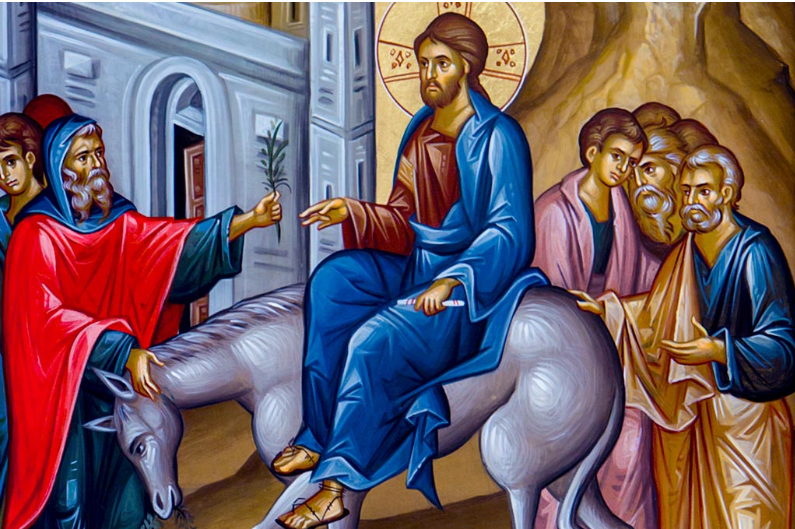
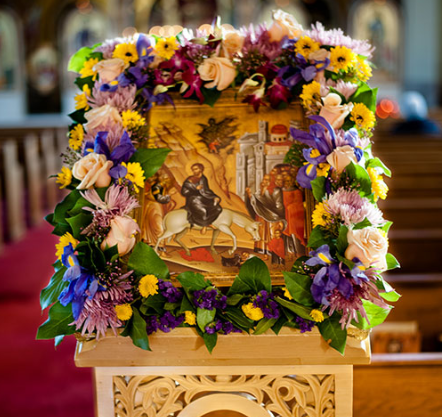
In the Icon of the Feast of Palm Sunday, Christ is the central figure, depicted seated upon the colt of a donkey as He enters Jerusalem, a fulfilment of the prophecy found in Zechariah 9:9. Christ is blessing with His right hand, and in His left hand is a scroll, symbolising that He is the fulfilment of the Old Testament prophecies concerning the Messiah, the Anointed One who has come to redeem us from our sins and break the power of death. The colt, one of the animals that were considered unclean according to the Law, is symbolic of the inclusion of all peoples of all nations in the new covenant that will come through the death and Resurrection of Christ (Isaiah 62:10-11). It is also a sign that our Lord has revealed a heavenly and spiritual kingdom that offers true and enduring peace.
On the right, the disciples accompany Jesus in His Triumphal Entry. Depicted on the left are the Jews who greet Him crying “Hosanna! Blessed is he who comes in the name of the Lord, even the King of Israel!” The word “Hosanna” means “Save, I pray” or “Save now.”
The children are the small people who are greeting Christ with palm branches and laying these and their garments on the ground before Christ as tokens of honour for one who is acknowledged as a King. The city of Jerusalem is shown as the walled buildings, and the temple is depicted as the building with the dome.
Orthodox Christian Celebration of Palm Sunday
Palm Sunday is celebrated with the Divine Liturgy of Saint John Chrysostom, which is preceded by the Matins service. A Great Vespers is conducted on Saturday evening according to the order prescribed in the Triodion. Scripture readings for Palm Sunday are: At the Vespers: Genesis 49:1,8-12; Zephaniah 3:14-19; Zechariah 9:9-15. At the Orthros (Matins): Matthew 21:1-17. At the Divine Liturgy: Philippians 4:4-9; John 12:1-18.
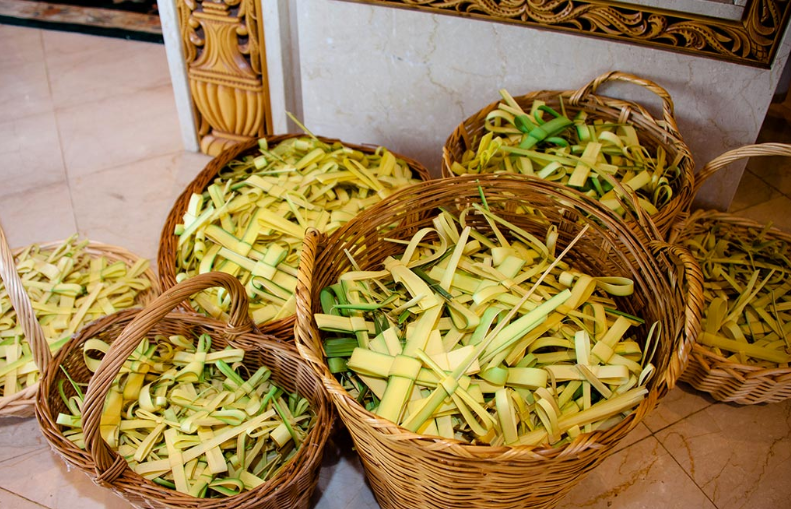
On this Sunday, in addition to the Divine Liturgy, the Church observes the Blessing and Distribution of the Palms. A basket containing the woven palm crosses is placed on a table in front of the icon of the Lord, which is on the Iconostasion. The prayer for the blessing of the Palms is found in the Ieratikon or the Euxologion. According to the rubrics of the Typikon, this prayer is read at the Orthros just before the Psalms of Praise (Ainoi). The palms are then distributed to the faithful. In many places today, the prayer is said at the conclusion of the Divine Liturgy, before the apolysis. The text of the prayer, however, indicates clearly that it is less a prayer for the blessing of the palms, even though that is its title, and more a blessing upon those, who in imitation of the New Testament event hold palms in their hands as symbols of Christ’s victory and as signs of a virtuous Christian life. It appears then, that it would be more correct to have the faithful hold the palms in their hands during the course of the Divine Liturgy when the Church celebrates both the presence and the coming of the Lord in the mystery of the Eucharist.
Source: Greek Orthodox Archdiocese of America